Red Light Therapy Panel vs Mask vs Belt: How to Choose the Right Form Factor
Panel, mask, belt, cap, or handheld? A clear buyer's guide to choosing the right red light therapy form factor by goal, coverage area, and the specs that actually matter.
So you have decided red light therapy is worth trying — but the catalog hits you with panels, face masks, belts, wraps, caps, and little handhelds, and the marketing for each one insists it is the obvious choice. Which red light device should you actually buy?
Short answer: choose the form factor by your main goal and the area you need to treat. Want whole-body recovery, big muscle groups, or skin over large areas? A panel is the most versatile pick. Focused on facial skin? A mask. A specific joint or your back? A belt or wrap. Thinning hair? A cap. A small, awkward spot you want to treat on the go? A handheld.
The form factor mostly changes how much skin you cover per session and how the light fits against your body. The underlying biology — red and near-infrared light absorbed by cells to support normal function — is the same across all of them. This guide walks through how to match the device to the goal, the three specs that actually decide whether a device works, and the mistakes that cost people money. If you would rather skip the reading, the device finder quiz maps your goals to a recommendation in about two minutes.
First principle: match the device to the goal, not the hype
Every form factor is just a different way of getting LEDs close to the tissue you care about. The questions that matter are simple:
- What is my primary goal? Recovery, facial skin, a specific joint, scalp and hair, or scattered targeted spots.
- How big is the area? Whole body, a region (back, thighs), the face, or a single small spot.
- How will I realistically use it? Standing in front of a panel daily is a different commitment than wearing a mask while you scroll your phone.
Get those three right and the form factor almost picks itself. The light’s depth of action is mostly set by wavelength, not by the shape of the housing: red light around 660 nm is absorbed largely in the skin, while near-infrared around 850 nm reaches deeper toward muscle and joints. Tissue modeling shows that longer (near-infrared) wavelengths penetrate further, and that a wider beam or larger illuminated area also reaches deeper than a tiny spot of the same wavelength Ash 2017. That single fact explains a lot of the form-factor differences below.
A quick vocabulary check, since the rest of this guide uses these terms:
- Wavelength (nm): the “color” of the light. 660 nm = visible red; 850 nm = invisible near-infrared.
- Irradiance (mW/cm²): how much light power lands on each square centimeter of skin — the intensity. Measured at a specific distance, which matters enormously.
- Dose (J/cm²): the total energy delivered, equal to irradiance multiplied by time. Dose is what biology responds to, and the response is biphasic — too little does nothing, and far too much can be counterproductive Hamblin 2017.
- Treatment area: how much skin the device lights up at once. This is the practical difference between “treat my whole back in 10 minutes” and “treat one knuckle at a time.”
With that, let’s go device by device.
Panels — whole-body recovery and large-area coverage
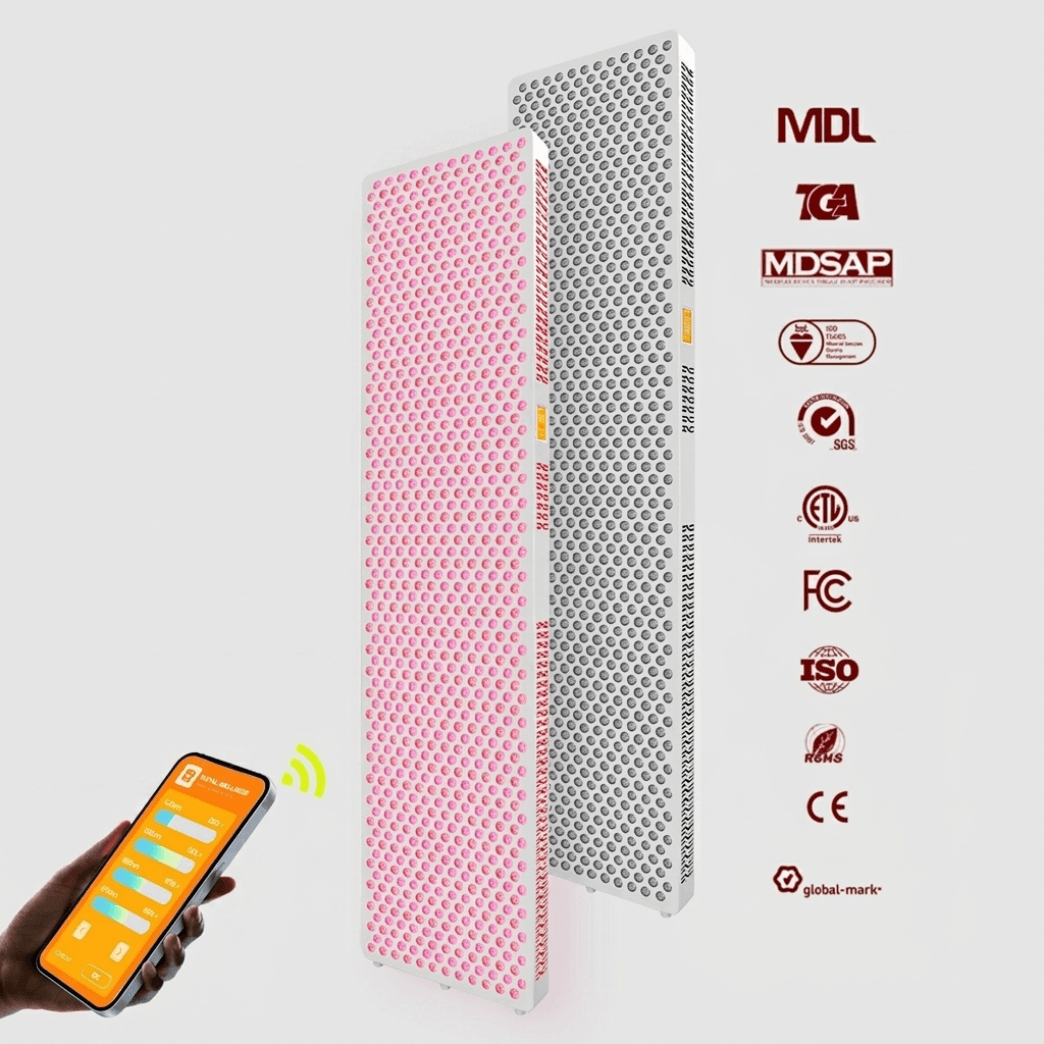
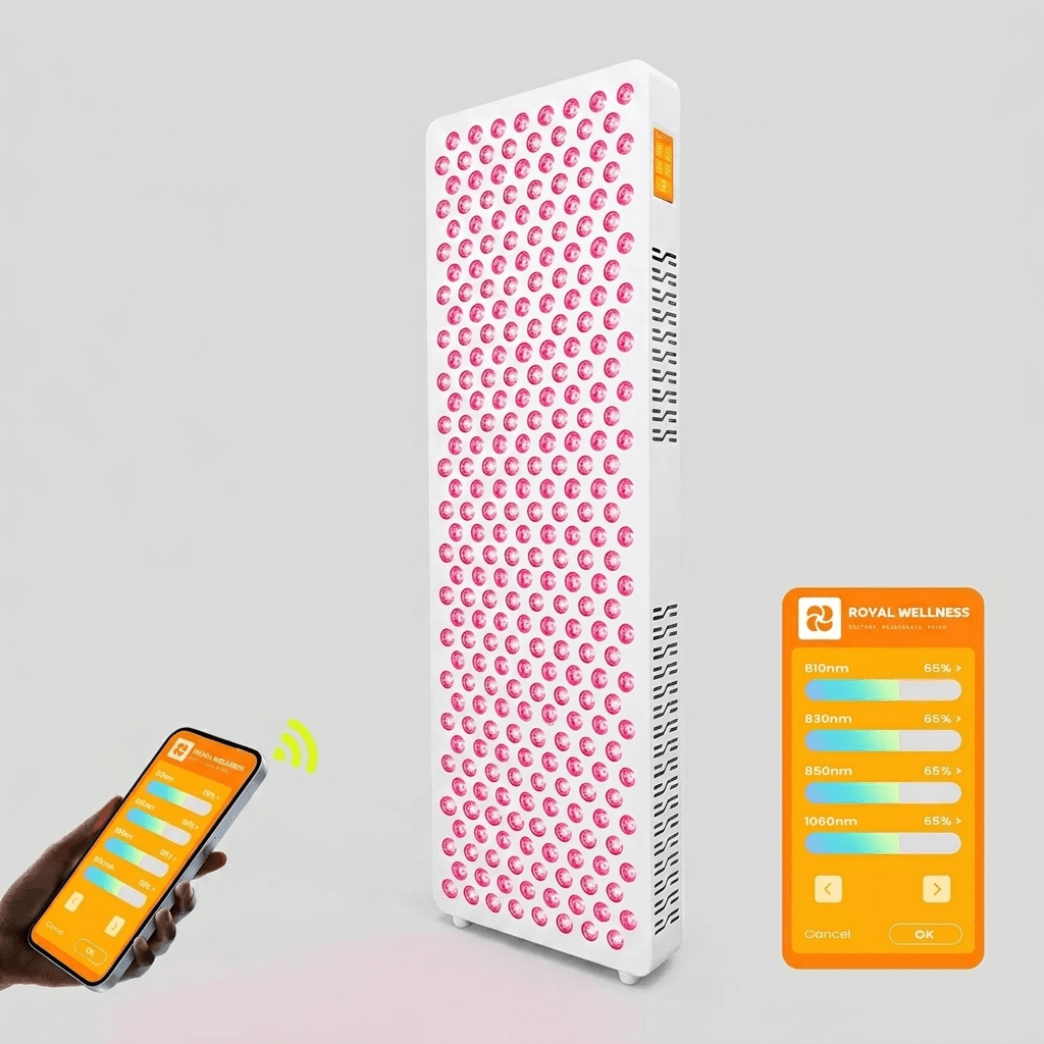
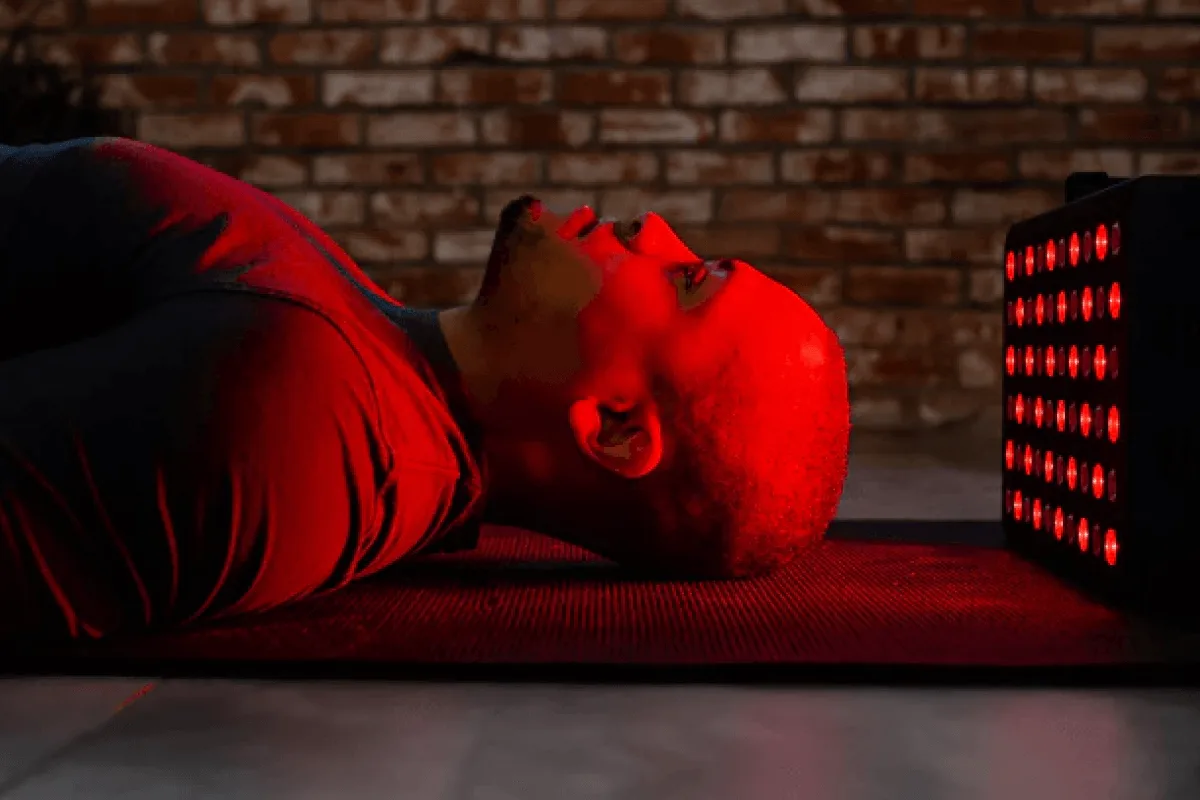
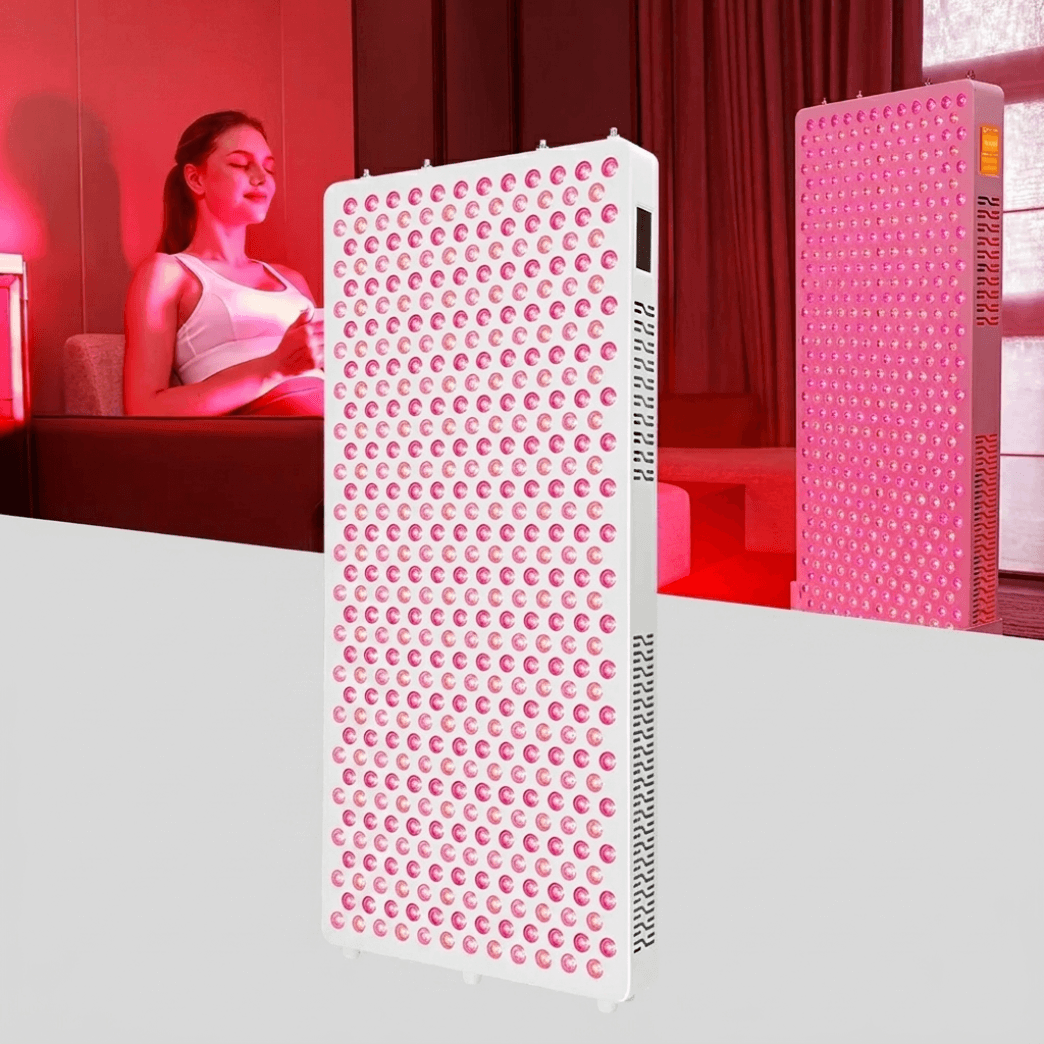
A panel is a flat array of LEDs you stand, sit, or lie in front of. It is the Swiss Army knife of red light therapy: nothing else covers as much skin per session, and nothing else is as easy to repurpose across goals.
Best for
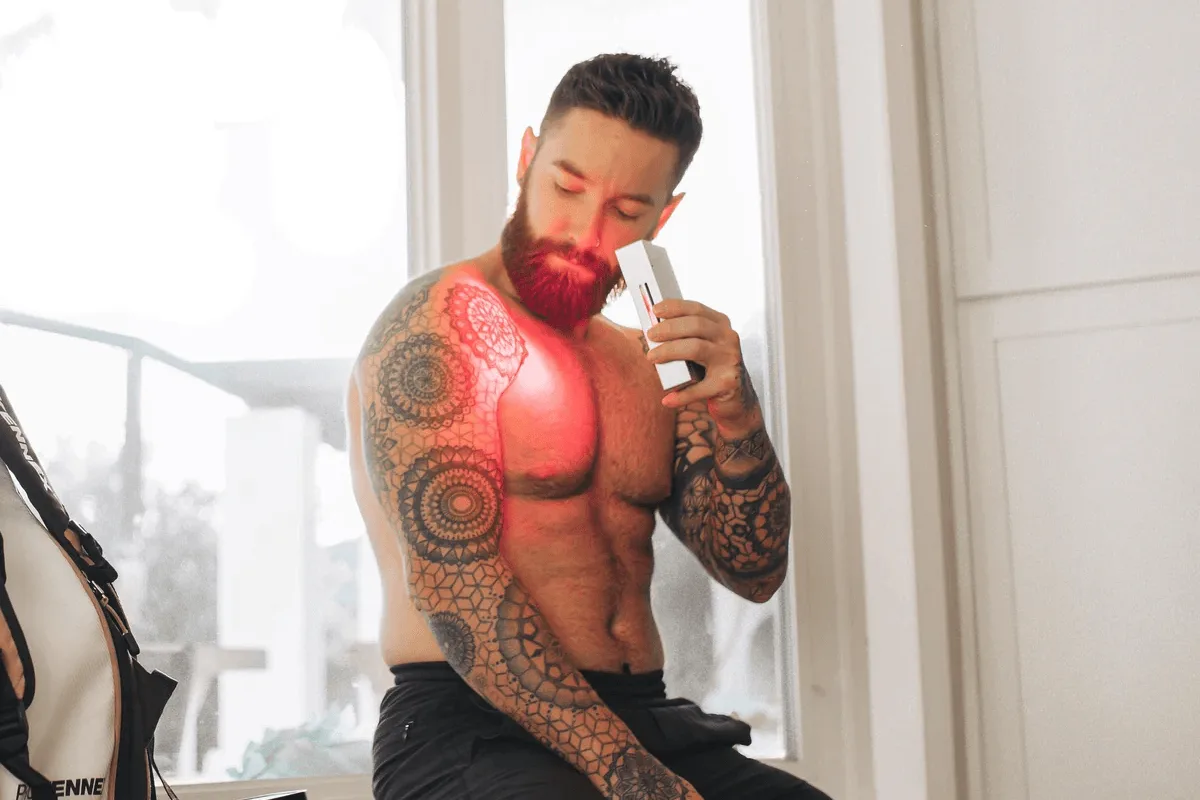
- Whole-body recovery after training or hard days — large muscle groups front and back. Meta-analytic evidence supports light therapy delivered before or after exercise for performance and recovery outcomes Vanin 2018.
- Skin over large areas — chest, back, arms, or full-face-plus-neck at once. The pivotal skin trial that improved collagen density and reduced wrinkles used large-area, full-body-style light sources Wunsch 2014.
- Multiple goals from one device — recovery on Monday, skin on Tuesday, a sore lower back on Wednesday.
Coverage and considerations
Coverage is the panel’s superpower and the source of its main trade-off: irradiance falls off quickly with distance, so a panel’s stated intensity only holds at a specific gap. Stand too far back and you stretch session times; stand too close and you shrink the area you are actually covering. Quality panels combine 660 nm and 850 nm so they serve both surface (skin) and deeper (muscle) goals de Freitas 2016.
Panels do take floor or wall space, and they ask you to hold a position for the session. If your priority is broad versatility, this is the foundation device — see the RoyalPRO Series or browse the full shop.
Masks — facial skin and neck
A face mask is a contoured shield, usually rigid or flexible silicone, studded with LEDs that sit close to or directly against facial skin. Its whole reason for existing is fit: the light meets your face evenly, hands-free, with no gap to manage.
Best for
- Facial skin goals — tone, texture, fine lines, and an even complexion. The skin-rejuvenation evidence base for red and near-infrared light is among the strongest in this field Wunsch 2014.
- Hands-free consistency — the biggest predictor of results is doing it regularly, and a 10-minute mask program you can wear on the couch is easy to keep up.
Coverage and considerations
A mask covers a small area — your face and sometimes neck — but it covers it well, because contact and contour beat distance. This is the cleanest example of why bigger is not always better: for facial goals, a snug mask can deliver a more consistent dose than a large panel used a foot or two away. Look for a mask with both red and near-infrared LEDs and built-in eye protection or a closed-eye protocol. Sessions are typically a fixed program of around 10 minutes. The RoyalGLOW Mask is built for exactly this use case.
Belts and wraps — joints, back, and targeted body areas
A belt or wrap straps the LEDs directly against a joint or a section of your torso, pressing them into contact so there is no air gap and no falloff with distance. It is the form factor for “I have one specific body part that needs attention and I want my hands free.”
Best for
- Specific joints — knees, elbows, shoulders — and the lower back. Near-infrared wavelengths are the relevant choice here because they reach deeper toward joint and muscle tissue Ash 2017.
- Targeted recovery and comfort wrapped around a single area while you move around the house.
- Abdominal or waist coverage when you want a defined, contoured region treated.
Coverage and considerations
A wrap covers a defined, curved region better than a flat panel can, because it conforms to the body part. The trade-off is the opposite of a panel: it is excellent at one area and useless for whole-body work. For deeper joint targets, near-infrared content matters, and dosing references such as the WALT dose tables underline that delivered energy at the target — not just the wattage on the box — is what counts WALT 2010. Sessions usually run 10 to 20 minutes. The RoyalFLEX Belt is designed for joints, back, and core.
Handhelds and caps — pinpoint spots and the scalp
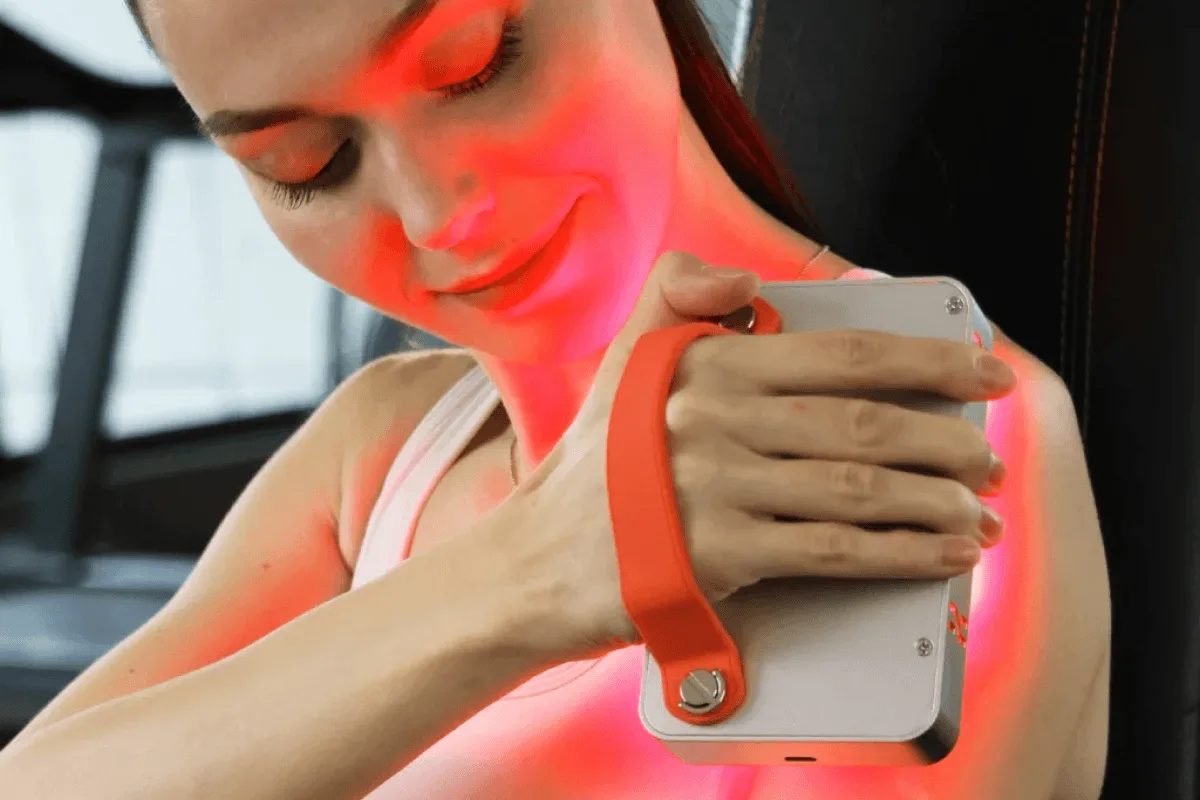
These two are specialists. A handheld is a small wand or torch for treating one spot at a time, by hand. A cap (or helmet) is a wearable array specifically shaped for the scalp.
Handhelds — best for
- Small, awkward, or scattered spots — a single knuckle, a specific patch of skin, a spot you want to treat at your desk or while traveling.
- Portability — the lightest, most packable option.
The catch is coverage: a handheld lights up only a small area, so anything larger means treating spot by spot, which takes time and patience. For one stubborn target it is perfect; for a whole region it is the slow road. The RoyalGO Handheld fits the travel-and-touch-up role.
Caps — best for
- Scalp and hair goals. Low-level light therapy applied to the scalp has controlled-trial support for hair density in pattern hair loss, and the cap form factor exists precisely because the scalp is a fixed, curved, hard-to-reach target a panel cannot serve well Avci 2014.
A cap’s coverage is narrow by design — the scalp — but it covers it hands-free and consistently, which is exactly what a daily or every-other-day hair protocol needs. The RoyalGROW Cap is purpose-built for this.
Comparison table: form factor at a glance
| Form factor | Best for | Coverage area | Typical session | Key consideration |
|---|---|---|---|---|
| Panel | Whole-body recovery, large-area skin, multiple goals | Largest — whole regions or near-full body | ~5–15 min per area | Most versatile; irradiance depends on your distance from the panel |
| Mask | Facial skin, tone, fine lines | Small but complete — face/neck | ~10 min program | Contact and fit beat a big panel for the face; needs eye protection |
| Belt / wrap | Joints, back, core, targeted areas | Defined curved region | ~10–20 min | Direct contact, no distance falloff; near-infrared matters for depth |
| Cap | Scalp and hair | Scalp only | Per device program | Purpose-built for a target panels can’t reach; needs consistency |
| Handheld | Small/awkward spots, travel | Smallest — one spot at a time | Longer per spot | Most portable; slow for large areas |
When the table feels like a coin toss between two options, that usually means either could work and the tie-breaker is lifestyle — which one will you actually use every day? The device finder quiz is built to settle exactly that.
The specs that actually matter
Ignore the buzzwords. Three numbers decide whether any device — regardless of shape — delivers a useful dose.
1. Wavelengths (660 nm and 850 nm)
This is the most important spec and the one most worth getting right. Red light near 660 nm is absorbed mainly in the skin and is the wavelength of interest for surface goals. Near-infrared near 850 nm penetrates deeper toward muscle and joints Ash 2017. A device that offers both covers the widest range of goals. Be a little skeptical of devices that lean heavily on the 700–770 nm range, which sits in a less-absorbed trough de Freitas 2016.
2. Irradiance (mW/cm²) — at a stated distance
Irradiance is the intensity hitting your skin, and it is meaningless without the distance it was measured at. A panel rated at a high irradiance “at the surface” will deliver far less six inches away. For contact devices like masks, belts, and caps, distance is essentially zero, which is part of why they can be efficient despite modest raw numbers. What you ultimately want is an adequate dose (J/cm² = irradiance × time) within the effective window — not the highest possible intensity, since the response is biphasic and more is not endlessly better Hamblin 2017.
3. Treatment area — and what it does to session time
Treatment area is the practical lever. A large panel reaches a target dose across a big region in one sitting; a handheld reaches the same dose per square centimeter but only over a tiny spot, so a large area becomes many sessions. Area and irradiance together set your session time. Established dosing references frame results in terms of energy delivered to the target, which is why “watts on the box” is a poor proxy for “useful device” WALT 2010.
A few secondary specs worth a glance: low EMF at the distance you will use the device, build quality and LED lifespan, and clear, honest documentation of the numbers above. You can dig deeper into the mechanisms on the science page.
Common mistakes when choosing a form factor
- Buying the biggest device “to be safe.” Coverage is great, but a panel you stand too far from, or never make time for, loses to a mask you wear nightly. Fit and habit beat raw size.
- Chasing the highest irradiance number. Intensity quoted without a distance is marketing, and beyond the effective dose window, more light does not mean more benefit Hamblin 2017.
- Ignoring wavelength mix. A red-only device limits you to surface goals; if joints or muscle are on your list, you need near-infrared too Ash 2017.
- Forcing one device onto every goal. A panel is poor for the scalp; a cap is useless for your back; a handheld is painfully slow for a whole region. Match the tool to the target.
- Skipping the basics of safe, consistent use. No device works if it sits in a drawer, and none should be used by staring into the LEDs.
A brief word on safety
Red light therapy is generally well tolerated, but use it sensibly: wear the eye protection supplied or recommended with your device — especially with bright panels or anything used near the face — and never stare directly into the LEDs. Follow the device’s distance and timing instructions rather than improvising longer or closer sessions, since more is not better. If you are pregnant, have a photosensitive condition, take photosensitizing medication, or have an eye condition, check with a qualified clinician first.
The bottom line
There is no single “best” red light device — there is a best device for your goal. Whole-body recovery and large-area versatility point to a panel. Facial skin points to a mask. A specific joint or your back points to a belt or wrap. Hair points to a cap. Scattered small spots and travel point to a handheld. Across all of them, the specs that decide success are the same: the right wavelengths (660 nm and 850 nm), enough irradiance at the distance you actually use, and a treatment area that fits your target without turning every session into a marathon. Bigger is not automatically better; the right fit for your goal is.
Still weighing two options? Let your goals decide for you — take the quiz to get a personalized recommendation in about two minutes, or browse the full lineup in the shop.
- Pick the device by your goal and the area you want to treat, not by which one looks most advanced. Coverage area is the single biggest practical difference between form factors.
- Panels cover the most skin per session and are the most versatile choice for whole-body recovery, skin, and large muscle groups. Masks, belts, caps, and handhelds trade coverage for fit, convenience, and hands-free targeting.
- Red (around 660 nm) is absorbed mainly in skin; near-infrared (around 850 nm) penetrates deeper toward muscle and joints. Most quality devices combine both.
- Three specs decide whether a device actually delivers a useful dose: wavelengths, irradiance (mW/cm² at your treatment distance), and treatment area. Together they set how long each session takes.
- Bigger is not automatically better. A face mask that hugs your skin can out-deliver a large panel for facial goals, because contact and fit drive the real dose to the target.
- Whatever you choose, use eye protection when light is near your face, follow the device's distance and timing instructions, and let goals — not hype — drive the decision. Not sure? The device finder quiz narrows it in two minutes.
FREQUENTLY ASKED
What is the difference between a red light panel, mask, and belt?
They differ mainly in coverage and fit. A panel is a flat array you stand or sit in front of, covering large areas like your whole back, chest, or legs in one session. A mask is a contoured face shield that sits directly on facial skin for even, hands-free coverage. A belt or wrap straps around a joint or your torso so the LEDs press against the target with no gap. Choose by the area you want to treat, not by the form factor alone.
Is a bigger red light panel always better?
No. A larger panel covers more skin per session and is more versatile, which is genuinely useful for whole-body goals. But for a specific target like your face or a single knee, a contoured mask or wrap that sits in direct contact can deliver a more consistent dose than a big panel used at a distance. The best device is the one that puts adequate irradiance on your actual goal area for the time you will realistically use it.
What wavelengths should a red light device have?
Most clinical and consumer red light devices use red light near 660 nm and near-infrared near 850 nm. Red is absorbed more in the skin and is associated with surface goals like skin tone and texture; near-infrared penetrates deeper and is the wavelength of interest for muscle and joint targets. A device offering both 660 nm and 850 nm covers the widest range of goals.
How long is a typical red light therapy session?
It depends on the device's irradiance and your target. Higher-output panels at a close distance often reach a useful dose in roughly 5 to 15 minutes per area; masks usually run a fixed program of about 10 minutes; belts and wraps commonly run 10 to 20 minutes; handhelds need longer per spot because they cover a small area. Always follow the specific device's instructions rather than guessing.
Do I need eye protection during red light therapy?
Use the eye protection supplied or recommended with your device, especially with bright panels or any device used near the face, and avoid staring directly into the LEDs. Many masks are designed with eye cut-outs or closed-eye protocols. Follow the manufacturer's safety guidance, and consult a clinician if you have an eye condition or take photosensitizing medication.
Should I buy a panel or a targeted device first?
If you have one clear, fixed goal — your face, your scalp, or one cranky joint — a purpose-built mask, cap, or wrap is often the better first buy because it fits the target perfectly and is easy to use consistently. If your goals are broad or likely to change (recovery plus skin plus the occasional sore back), a panel is the more flexible foundation. The device finder quiz can map your goals to a starting point.
REFERENCES
- 1. Hamblin MR. Mechanisms and applications of the anti-inflammatory effects of photobiomodulation. AIMS Biophys. 2017;4(3):337-361. doi:10.3934/biophy.2017.3.337 PMC5523874
- 2. de Freitas LF, Hamblin MR. Proposed mechanisms of photobiomodulation or low-level light therapy. IEEE J Sel Top Quantum Electron. 2016;22(3):7000417. PMC5215870
- 3. Wunsch A, Matuschka K. A controlled trial to determine the efficacy of red and near-infrared light treatment in patient satisfaction, reduction of fine lines, wrinkles, skin roughness, and intradermal collagen density increase. Photomed Laser Surg. 2014;32(2):93-100. doi:10.1089/pho.2013.3616 PMC3926176
- 4. Ash C, Dubec M, Donne K, Bashford T. Effect of wavelength and beam width on penetration in light-tissue interaction using computational methods. Lasers Med Sci. 2017;32(8):1909-1918. doi:10.1007/s10103-017-2317-4 PMC5653719
- 5. Avci P, Gupta GK, Clark J, Wikonkal N, Hamblin MR. Low-level laser (light) therapy (LLLT) for treatment of hair loss. Lasers Surg Med. 2014;46(2):144-151. PMC3944668
- 6. Vanin AA, Verhagen E, Barboza SD, Costa LOP, Leal-Junior ECP. Photobiomodulation therapy for the improvement of muscular performance and reduction of muscular fatigue associated with exercise in healthy people: a systematic review and meta-analysis. Lasers Med Sci. 2018;33(1):181-214. PMID 29090398
- 7. World Association for Laser Therapy (WALT). Recommended treatment doses for low level laser therapy: dose table 780-860 nm (WALT-2010). WALT 2010
ABOUT THE AUTHORS
Our team reviews the peer-reviewed literature on red and near-infrared light therapy and translates it into honest, practical guidance — no hype, just what the evidence actually supports.